



Predictive vs. Preventive Maintenance: When to upgrade your sensors to avoid unscheduled downtime?
In the modern manufacturing environment, downtime is the number one enemy of profitability. For a Plant Manager or Maintenance Supervisor, asset management has always oscillated between two philosophies: preventive maintenance and predictive maintenance.
- Preventive Maintenance: Based on time or usage cycles. Components are replaced according to a strict calendar or operating hours. This often leads to replacing parts that still have useful life—or worse, unexpected failures occurring before the scheduled date.
- Predictive Maintenance: Based on the real-time condition of the asset. The machine is intervened only when the data indicates it is about to fail.
The bridge between both strategies lies in a critical element of the automation pyramid: sensors. They are the “eyes” of the plant. If your sensors are blind to internal diagnostics, your maintenance strategy will be too.
Traditional Sensors vs. Smart Sensors
Transitioning to Industry 4.0 and predictive maintenance does not require reinventing all the machinery in the plant; it requires upgrading the components that capture information. This is where IO-Link technology has consolidated itself as the global standard for smart sensorization.
Below, we analyze the operational differences between legacy technology and latest-generation devices:
| Feature | Traditional Sensors (Analog / Binary) | Smart Sensors (with IO-Link) |
| Signal Type | Binary switching (ON/OFF) or simple analog (4 – 20 mA or 0 – 10 V). | Digital and bi-directional via the standard IO-Link protocol. |
| Status Diagnostics | None. If the lens gets dirty or the sensor becomes misaligned, the machine simply stops without warning. | Continuous self-diagnostics. Alerts for loss of gain, dirt accumulation, or misalignment before a fault occurs. |
| Measured Variables | A single process variable (e.g., presence, distance). | Multivariable. Measures the primary variable plus secondary data such as internal temperature and operating hours. |
| Configuration | Manual via potentiometers or physical buttons on the device itself (prone to human error). | Remote configuration. Parameters are automatically uploaded from the IO-Link master in seconds. |
When is the exact time to upgrade? (Warning signs in your plant)
You do not need to replace every sensor in the factory overnight. Hardware upgrades should be strategic, prioritizing critical points where the financial and operational impact is highest:
1. High-speed critical lines (Bottlenecks)
Identify processes where an unscheduled 10-minute stoppage costs thousands of dollars ($) in penalties or wasted product. Replacing standard proximity sensors or photoelectric cells in that area with IO-Link smart sensors transforms a critical risk into a controlled environment.
2. Hard-to-reach areas or harsh environments
Visual preventive maintenance is unfeasible on sensors installed inside extraction hoods, high-temperature zones, or complex robotic arms. Smart sensors from leading brands monitor their own internal temperature and vibration levels, sending an alert to your PLC or SCADA before a thermal or mechanical failure occurs.
3. High rates of false positives and micro-stoppages
If your maintenance team spends hours readjusting potentiometers due to ambient light variations, dust buildup, or structural vibrations, you are losing OEE (Overall Equipment Effectiveness). An IO-Link sensor intelligently notifies: “Cleaning required”, instead of stopping the line due to a false alarm.
The Return on Investment (ROI) of hardware upgrades
Let’s be realistic: a smart sensor with IO-Link technology represents a higher initial investment than a generic traditional component. However, when analyzed from the perspective of plant financial KPIs, the ROI is immediate.
- Payback in a single stoppage: Avoiding just one unscheduled line stoppage more than pays for upgrading an entire section of the plant.
- Reduction of dead inventory: With traditional sensors, you need to store dozens of variants depending on range, output (NPN/PNP), or contact type (NO/NC). With software-configurable smart sensors, a single model can cover multiple applications, drastically reducing capital tied up in the spare parts inventory.
Pymatek as your strategic hardware ally
At Pymatek, we understand that successful predictive maintenance does not depend on costly field consultancies or on-site engineering—it depends on having immediate access to the right hardware. We do not offer repair services or field maintenance; our core value is ensuring your plant has latest-generation automation components exactly when needed.
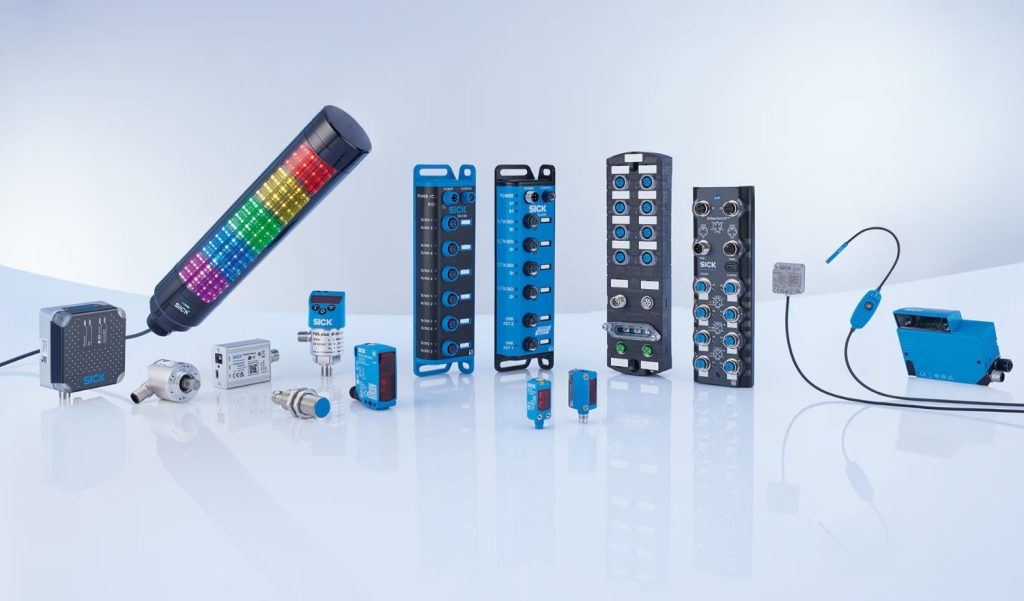
We work hand-in-hand with the industry-leading brands that dictate the standard in IO-Link technology and sensor innovation (SICK, Balluff, Pepperl+Fuchs, Omron, among others).
- Guaranteed stock: We minimize your lead times so that planned upgrades are executed without delays.
- Direct compatibility: We provide the exact hardware that integrates natively with your current control architecture.
Take the step toward full plant visibility
Operating your plant with traditional sensors is equivalent to driving in the dark, waiting for the engine to fail. Moving to predictive maintenance starts by equipping your machines with the ability to communicate.
Which areas of your production line are still working blindly?
Contact us to request the hardware, smart sensors, and IO-Link masters your next maintenance window needs to eliminate unscheduled downtime.
Recent Comments